Choosing Your Materials
Backyard Fence Inspiration: Privacy, Pet Safety & Decorative Styles
A practical guide to backyard fencing for Columbus homeowners, covering privacy options, pet-safe designs, and decorative styles that enhance curb appeal.
A practical guide to backyard fencing for Columbus homeowners, covering privacy options, pet-safe designs, and decorative styles that enhance curb appeal.

A backyard fence can do a lot of things at once. It can give you privacy, keep pets safe, and make the property look better in the process. Most Columbus homeowners are looking for at least two of those three, and often all of them.
The right backyard fencing makes that possible. It comes down to knowing which types of fences work best for each goal and how to balance them when your priorities overlap. This guide walks through the main options for privacy, pet safety, and decorative appeal, with honest notes on trade-offs along the way.
The right backyard fence balances three things: privacy, pet safety, and how the property looks from the street. For privacy, board-on-board construction at 6 feet is the most effective option in Columbus. For pets, height, board spacing, and gate security matter as much as the fence style itself. For curb appeal, picket, shadowbox, and lattice-top designs are the most popular choices among Columbus homeowners right now.
Privacy is the most common reason Columbus homeowners start thinking about a fence. A well-chosen design can make a backyard feel genuinely secluded, even on a lot with close neighbors.
That said, not all "privacy fences" offer the same level of screening. Construction style matters just as much as height.
Both styles look solid at first glance, but they perform quite differently.
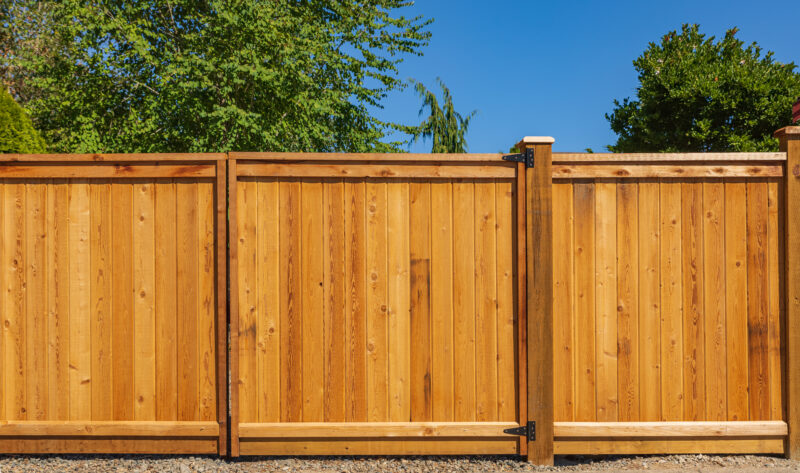
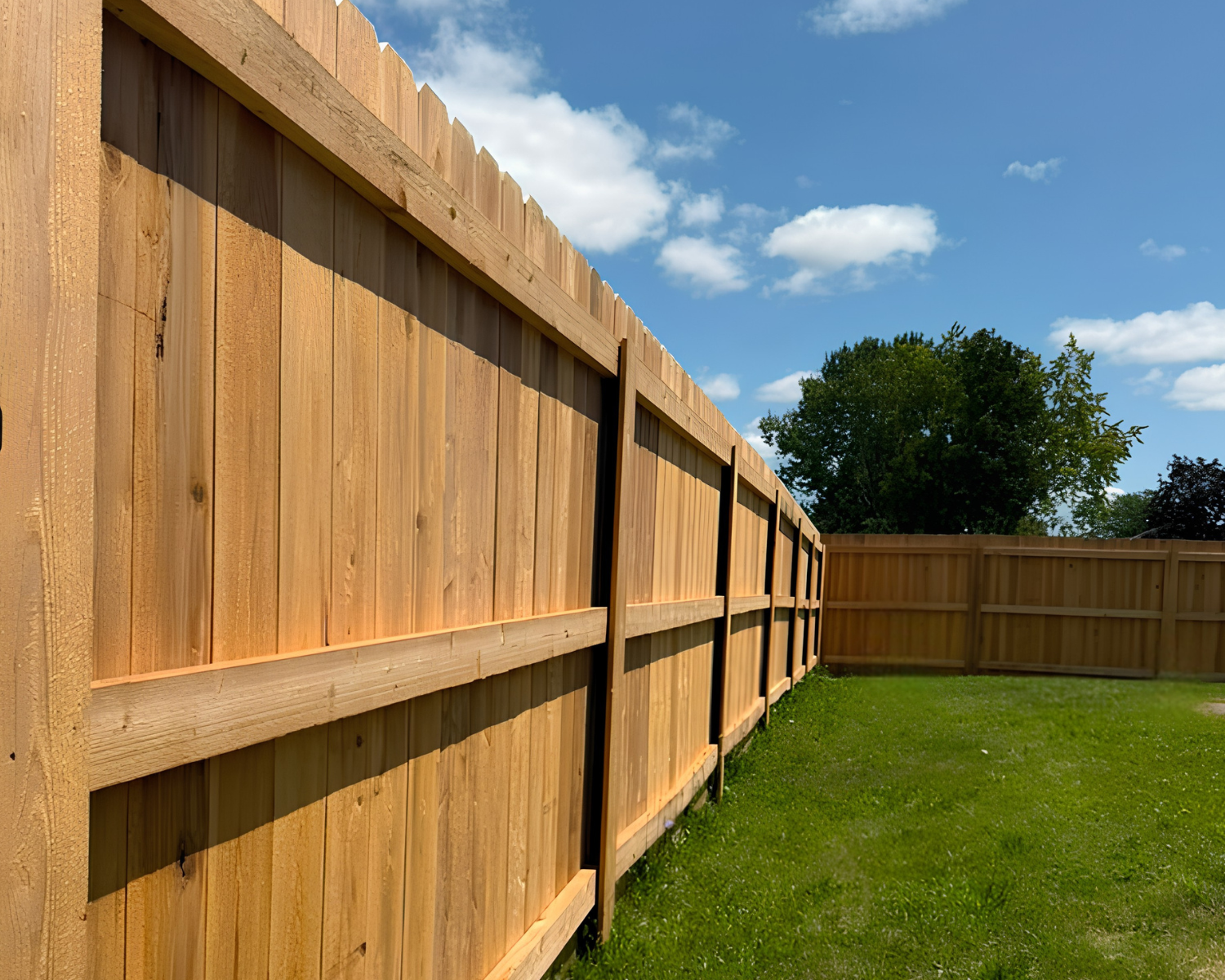
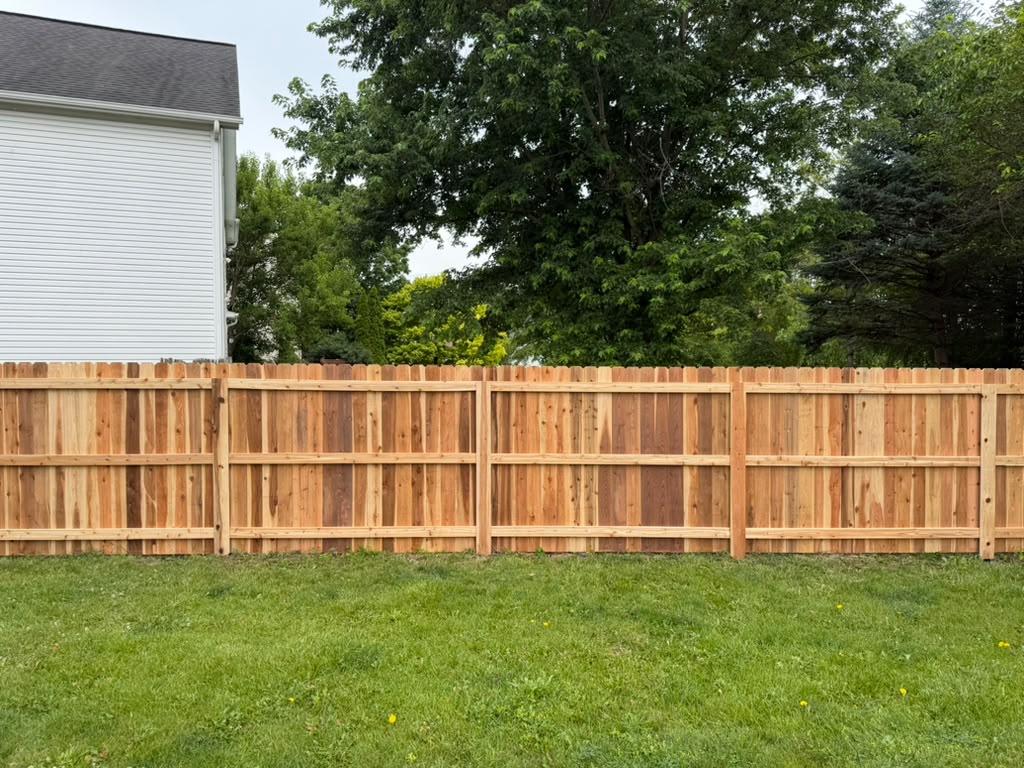
Board-on-board construction places overlapping boards on the same side of the rails, creating a truly solid barrier with no gaps. If complete privacy is your goal, this is typically the way to go.
Shadowbox construction alternates boards on opposite sides of the rails. It looks private when viewed straight on, but from an angle you'll notice gaps. Some homeowners are surprised by this after installation. The upside is that shadowbox handles wind better and looks the same from both sides, which neighbors tend to appreciate.
Most privacy fences sit in the 6-foot range. In the City of Columbus, a 6-foot rear yard fence generally doesn't require a permit and can be placed right at the property line. Go taller than 6 feet and a permit is typically required.
Suburb rules vary more than most homeowners expect. Dublin limits rear yard fences to just 4 feet, which catches a lot of people off guard. Powell and Upper Arlington have their own restrictions too. Zoning codes can change, so it's always worth confirming the current requirements with your local municipality before finalizing any plans.
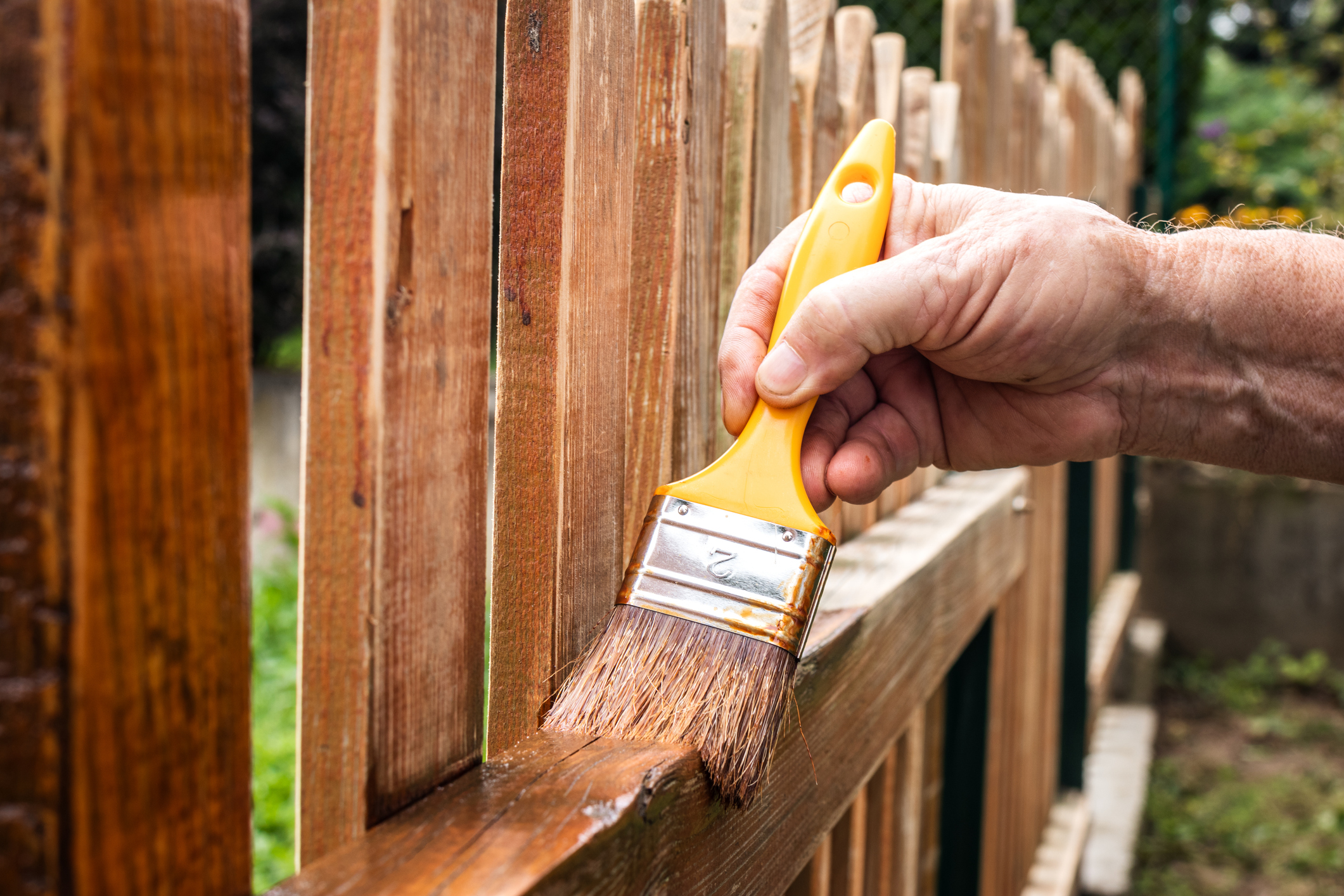
Cedar is a popular choice for privacy applications. It has a natural look that ages well and holds up reasonably in Ohio's climate. Pressure-treated pine is another option that performs well, though it typically needs more maintenance over time.
Vinyl has become a go-to for many Ohio homeowners because of how well it handles freeze-thaw cycling. It's non-porous, so it doesn't absorb moisture the way wood does, keeping it more stable through seasonal temperature swings.
| Material | Typical Lifespan | Ohio Performance |
|---|---|---|
| Cedar | 10–30+ years | Natural look, needs restaining every few years |
| Pressure-treated pine | 10–25+ years | Durable, requires more regular upkeep |
| Vinyl | 20–30+ years | Handles freeze-thaw well, very low maintenance |
For a deeper look at how these materials compare, our guide to fence materials covers the full picture.
If you have a dog, the fence has a job beyond looking good. It needs to actually contain your pet, and that means thinking through height, spacing, dig prevention, and gate security before settling on a style.
A 6-foot fence will contain the vast majority of dogs. For smaller dogs under 20 pounds, 4 feet is often enough. Medium dogs in the 20 to 50 pound range do better with 5 to 6 feet, and larger dogs should have a full 6 feet.
Height isn't only about keeping your dog in. Smaller dogs in wooded areas or on the outskirts of Columbus can be vulnerable to coyotes, and a taller fence keeps predators out as well.
Some breeds need extra consideration. Huskies, Malamutes, and Great Pyrenees are determined escape artists, and surprisingly creative about it. Greyhounds and other sighthounds present a different challenge since they can clear a 6-foot fence without much of a running start. For dogs like these, 6 to 8 feet plus some additional measures is worth considering.
Some dogs go under rather than over. For diggers, a few solutions work well:
Board spacing is worth thinking through carefully as well. Gaps that seem small can be enough for certain dogs to squeeze through:
Gates are often where containment breaks down. Self-closing hinges are a good foundation since they eliminate the risk of a gate left accidentally open. For the latch, a dog kennel style with a lift-and-turn mechanism works well since dogs can't flip it on their own. If your dog tends to rush the gate, a double-gate airlock system creates a buffer zone that prevents escape even when the outer gate opens.
If your dog barks at every passing person or squirrel, a solid privacy fence can help. When dogs can't see the trigger, they tend to settle down. Dogs who are calm and enjoy watching the world may do fine with a more open style.
Pet safety is a topic we cover in more depth in our guide to dog-friendly fencing, which goes further into breed-specific considerations and containment options.
A fence is part of how your home presents itself to the street. The right decorative fence style adds character without calling attention to itself, and pulls the property together in a way that feels intentional rather than afterthought.
These are some of the styles Columbus homeowners have been drawn to lately.
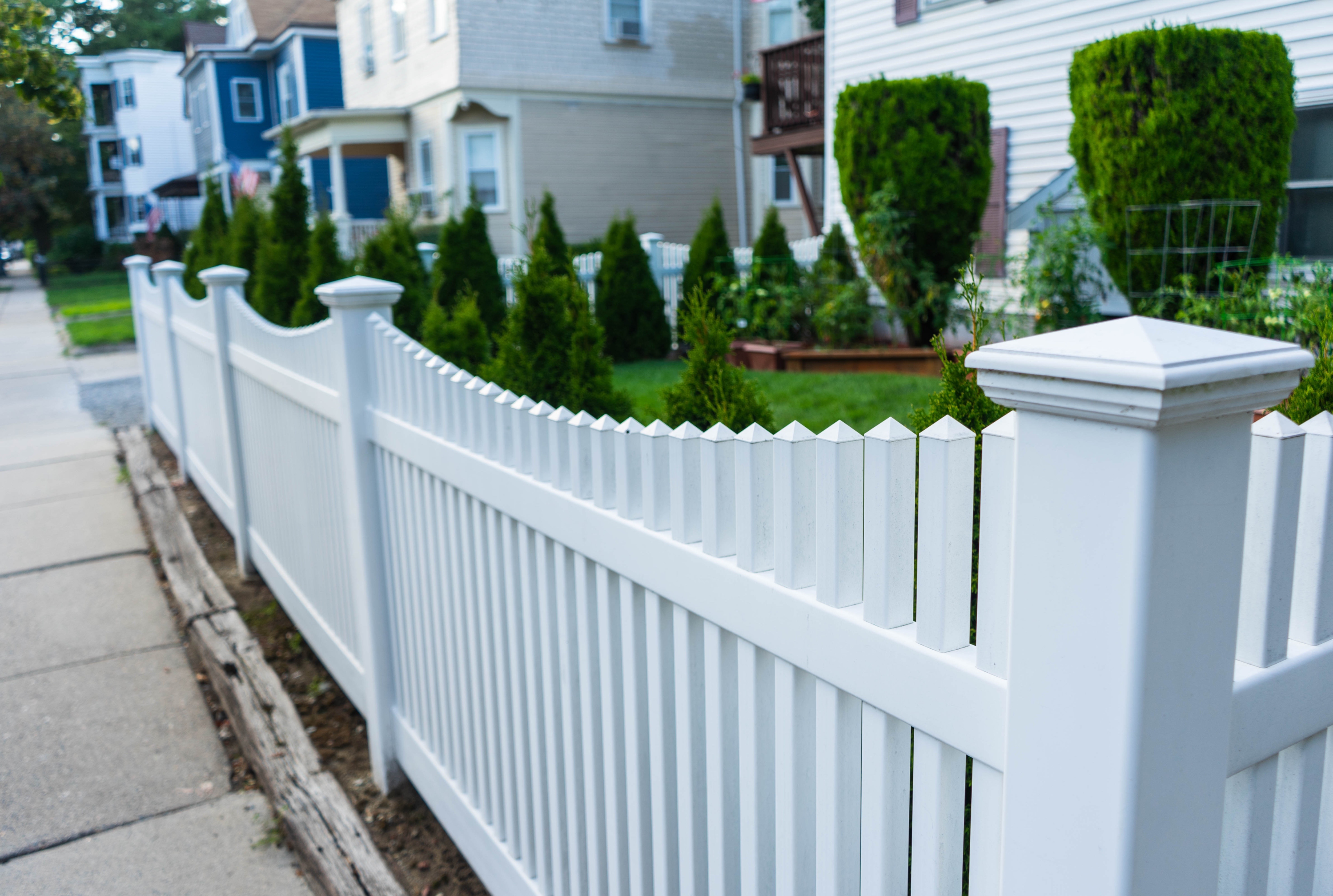
Picket fences are classic for a reason. They're welcoming, work with a wide range of home styles, and typically stand 3 to 4 feet tall with 2 to 3 inch spacing between pickets.
The top style makes a meaningful difference in how the fence reads. Dog-ear cuts are the most common. Gothic tops create a pointed, formal look. French Gothic adds a concave curve that pairs well with Victorian homes. Flat tops feel more modern and minimalist.
Lattice-top fencing adds 12 to 24 inches of decorative lattice above a solid base. You get privacy where it counts while letting light through at the top. It works particularly well with climbing plants, which fill in the lattice over time and add seasonal color.
Shadowbox fencing alternates boards on both sides of the rails so it looks the same from either side. There's no back of the fence facing the neighbors, which tends to go over well on shared property lines.
Scalloped fences curve between posts rather than running in a straight line. A concave scallop dips down in the center. A convex scallop arches upward for a more formal look. Both add visual interest on longer fence runs where a straight top can feel flat.
Post caps are a finishing detail that ties the fence together. Options include wood, vinyl, metal, and copper, which develops a natural patina over time. Solar caps with LED lights are also popular since they add soft lighting along the fence line without any wiring.
The best backyard fencing projects rarely focus on just one thing. Privacy, pet safety, and curb appeal can work together in a single design when the planning is thoughtful. A few approaches make that easier.
Horizontal boards have a clean, modern feel that makes a yard look more spacious. They do require posts every 6 feet rather than the standard 8, along with center supports to prevent sagging. The finished result is sharp, but the installation is less forgiving than a standard vertical fence.
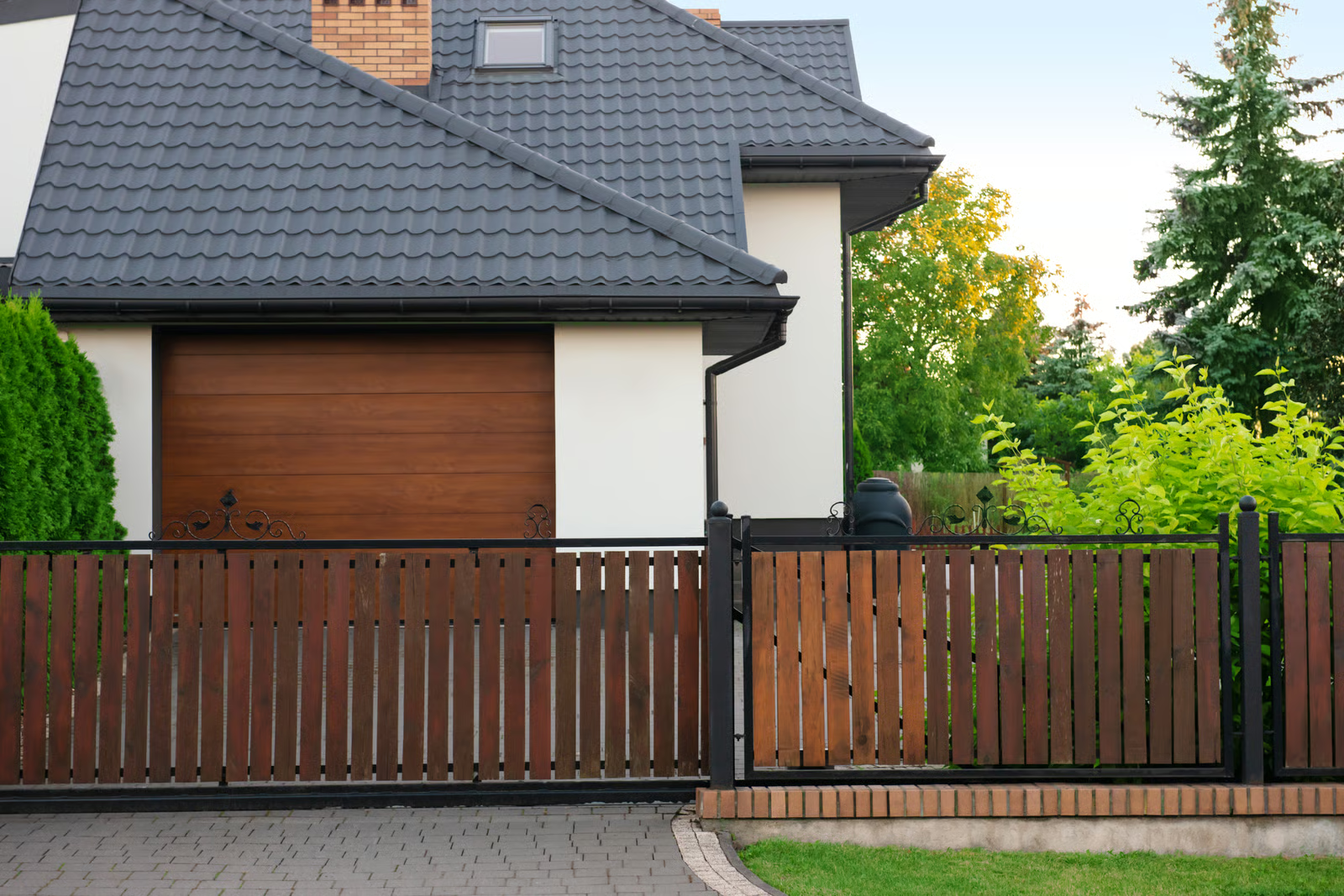
A custom fence doesn't have to be a single material. Metal posts with wood infill keep wood off the ground where moisture is highest, which extends the fence's life. Stone or brick columns with wood or metal panels add visual weight and tend to hold up well over time. Mixed-material builds often outperform single-material ones precisely because each component is doing what it does best.
Fences and landscaping work well together. Arborvitae or boxwood along the fence line adds a layer of privacy and softens the hard edge of the structure. Climbing plants on a lattice or trellis-style fence bring seasonal color and texture. It takes a few seasons to fill in, but the result feels more like a garden boundary than a barrier.
On sloped ground, stepping (level sections that follow the grade in increments) works best for steeper inclines, while racking (panels angled to follow the slope continuously) suits gentler hills. For style changes between the front and back yard, keeping the same post style throughout is the simplest way to make the whole fence feel like one intentional design rather than two separate ones.
For true privacy, a 6-foot board-on-board fence is typically the most effective option. The overlapping boards leave no gaps, even as the wood dries and shrinks over time. Vinyl at the same height performs similarly and holds up particularly well through Ohio's freeze-thaw cycles. If you're in a suburb, check local height limits before finalizing anything since rules vary by municipality.
Start with height. A 6-foot fence contains most dogs, though athletic or escape-prone breeds may need closer to 8 feet. For diggers, an L-footer wire mesh or partially buried rocks along the base can help. Keep board gaps under 4 inches for most dogs, and 3 inches or less for smaller breeds. Self-closing hinges and a lift-and-turn latch on the gate round out a solid containment setup.
Picket fences are a classic choice that work with a wide range of home styles. Lattice-top fencing adds height and visual interest without feeling like a solid wall. Shadowbox designs look the same from both sides, which neighbors tend to appreciate. Scalloped tops and decorative post caps are smaller details that add character without changing the overall structure.
Yes. Metal posts with wood infill is one of the more popular combinations since the metal keeps wood off the ground where moisture is highest. Stone or brick columns with wood or metal panels add visual weight and hold up well over time. Mixing materials often improves durability because each component is doing what it does best.
It depends on the project. Straightforward layouts on flat ground can be manageable for experienced DIYers. For sloped yards, longer runs, custom designs, or any project where post depth and alignment matter, professional installation tends to produce better long-term results. A pro will also know local permit requirements and make sure everything is set correctly from the start.
The advice we give most often is to start with function and let style follow from there. A fence that looks great but doesn't give you the privacy you wanted, or lets the dog out twice a week, isn't doing its job. Getting clear on your priorities before choosing a style makes the whole decision easier and the result more satisfying.
For most Columbus backyards, a 6-foot board-on-board or shadowbox fence in cedar or vinyl covers the majority of needs. It provides real privacy, contains most dogs, and looks clean alongside a range of home styles. From there, details like post caps, scalloped tops, or a lattice addition can bring in character without complicating the build. The goal is a fence that works first and looks good doing it.
Privacy, pet safety, and curb appeal don't have to be separate projects. With the right design, a single fence can handle all three. It just takes some planning upfront and a clear sense of what matters most for your property.
At Fence Boys, we work with Columbus homeowners to design backyard fencing that fits the yard, the home, and the people using it. We're happy to walk your property, talk through your options, and help you land on something that works well for years to come.
Ready to Design a Backyard Fence That Does It All?
Fence Boys helps Columbus homeowners find the right balance of privacy, pet safety, and curb appeal — then installs it right.
Get a Free Quote


.jpg)
.jpeg)

.jpg)









.jpeg)